

all-news
month

A Student Roundtable was held on the occasion of the 70th anniversary of Nobel laureate David Card
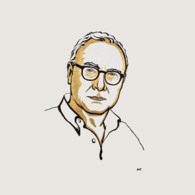
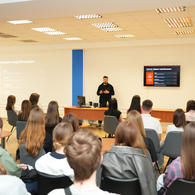
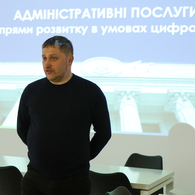
On November 19, 2026, the State University of Trade and Economics hosted a student roundtable meeting "Natural Experiments in Economic Theory: Applied Aspects for Ukraine", dedicated to the 70th birthday of Nobel Memorial Prize in Economic Sciences laureate David Card – one of the most influential modern empirical economists and a founder of the "credibility revolution" in economic science.
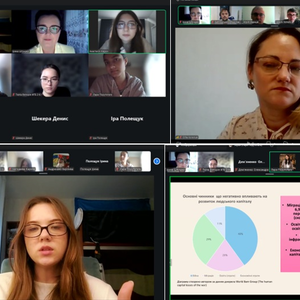
The event brought together nearly thirty active and creative students who presented their own research and engaged in a lively academic discussion on applying the natural experiment method, developing human capital, and adapting the labor market amid wartime shocks. Students were mentored by faculty members from the SUTE Departments of Economic Theory and Competition Policy, International, Civil, and Commercial Law, and Economics and Business Finance, as well as a faculty member from the Department of Finance at Borys Grinchenko Kyiv Metropolitan University.
The objective of the roundtable was to present, discuss, and synthesize the results of student research on pressing issues regarding the practical significance of David Card's ideas for evidence-based economic policymaking, labor market regulation, and the post-war recovery of Ukraine.
Welcoming remarks were delivered by Olha Koreniuk, Dean of the Faculty of Economics, Management and Psychology, and Yurii Umantsiv, Head of the Department of Economic Theory and Competition Policy. Both emphasized the growing role of empirical research and evidence-based approaches in explaining modern socio-economic processes, as well as the vital importance of student scholarship.
The roundtable was moderated by faculty members of the SUTE Department of Economic Theory and Competition Policy: Iryna Shtunder, Vadym Yemets and Vasyl Hanovskyi, who guided the academic discussion and facilitated active debate on the presented studies.
The event featured three thematic panels.
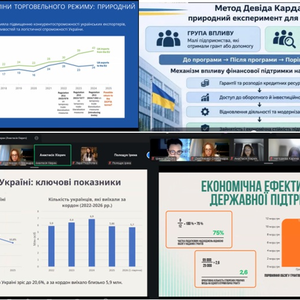
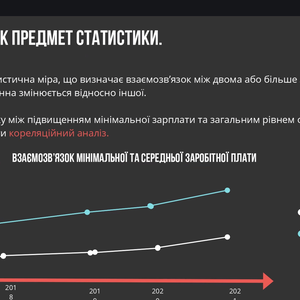
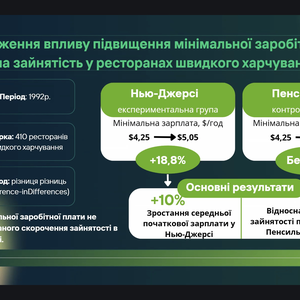
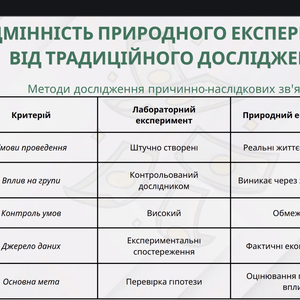
Panel 1 (moderated by Vasyl Hanovskyi, PhD in Economics, Assistant Professor) focused on natural experiments, their theoretical foundations, methodology, and the scientific legacy of David Card. Participants discussed empirical and quasi-experimental methods for evaluating causal relationships in labor market research, alongside the impact of tax and economic shocks on public welfare. Special attention was given to the practical relationship between minimum wage increases and employment levels based on David Card's research, as well as opportunities to implement these insights into Ukraine's current economic policy.
Panel 2 (moderated by Iryna Shtunder, Doctor of Economics, Professor) centered on evidence-based policy, human capital development, and social mobility. Student presentations examined the impact of educational attainment and higher education on career opportunities, wages, and future earnings of young people within the framework of David Card's concepts. Participants also analyzed the macroeconomic consequences of labor migration, the development of enterprise labor potential under martial law, the impact of state support on small and medium-sized businesses, and the economic effects of changes in the EU trade regime toward Ukraine.
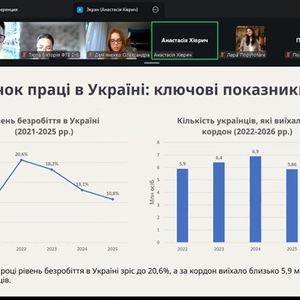
Panel 3 (moderated by Vadym Yemets, Doctor of Economics, Associate Professor) was dedicated to analyzing wartime shocks and the adaptation of Ukraine's economy through the lens of the labor market, business, and sectoral resilience. The discussion covered labor shortages, unemployment, and the "relaunch" of the labor market under wartime conditions, particularly due to forced and labor migration. Particular emphasis was placed on the resilience of regional retail markets amid disrupted supply chains, small business adaptation, and ensuring the resilience of agricultural export enterprises and the domestic IT sector to wartime shocks.
The roundtable served as an important platform for student academic communication, idea exchange, and understanding modern socio-economic transformations through an evidence-based lens. The submitted research demonstrated a high level of student engagement with pressing issues in economic science and their readiness to contribute to academic debates on Ukraine's post-war recovery and development.
The Organizing Committee extends its sincere gratitude to the moderators and all roundtable participants for their inspiration, insightful ideas, and thorough analysis of contemporary challenges. Such academic discussions foster a new generation of professionals and advance economic science in Ukraine.
Viktoriya Khrustalova,
Associate Professor, Department of Economic Theory and Competition Policy


Фотогалерея