

DAAD East-West Partnership: «Дезінформація та право у сфері ШІ»


Анонси
About the project
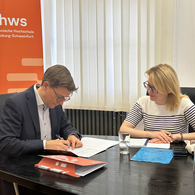
The “Disinformation and AI Law” (DAIL) project is designed to counter AI-scaled disinformation—a critical threat to information integrity and public trust. With funding from DAAD, we have joined forces between two leading institutions: the Würzburg–Schweinfurt University of Applied Sciences (THWS) and the State University of Trade and Economics. Our goal is to combine cutting-edge technological solutions with legal instruments to safeguard democratic values in the digital sphere.
With a focus on combating disinformation, the Disinformation and AI Law (DAIL) project addresses an issue of existential importance for social cohesion, trust in state institutions and democracy as a form of government. Taking all measures and activities together, the topic is being addressed at the level of master's students, young researchers and professors in an international and interdisciplinary manner in teaching and research, both technically and legally. While those directly involved in the project are gaining professional and personal expertise, the published project results have the potential to be taken up by legislators, politicians, businesses and society as a contribution to combating disinformation.
Legally, the following project-leading topics are being addressed in relation to combating disinformation:
Service provider regulation under the EU Digital Services Act and Ukrainian law
Risk classification and resulting obligations under the EU AI Act and Ukrainian law
Transparency and explainability under the EU AI Act and Ukrainian law
Technically, a possible approach for an AI model and three typical AI tools for combating disinformation will be outlined in such a way that, on this basis, legal framework requirements that are as transferable as possible can be developed. The subjects under consideration are:
A multi-modal, transparent, user-centred and responsively explainable open-source AI model for detecting and classifying disinformation.
A browser plugin that enables users to automatically detect and flag disinformation on displayed web pages.
A plugin for WordPress to enable website and platform operators to integrate automatic verification mechanisms for third-party posts and comments.
A gamification approach for an interactive, browser-based game that encourages participation in political discussions while training users to recognise and avoid misinformation. The game would reward users for engaging in reasonable, fact-based dialogue.
These results will be achieved through the following measures/activities:
| Measure / Activity | Description & Key Outcomes |
| 1. Scholarship Stay | Three SUTE researchers conduct intensive research at the Centre for Artificial Intelligence of Würzburg-Schweinfurt University of Applied Sciences (THWS CAIRO). Focus: Digital Services Act, EU AI Act, and Ukrainian legal alignment. |
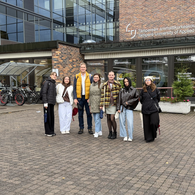
| 2. Short-term mobility programme | 9 SUTE students + 2 lecturers visit THWS. Students form interdisciplinary teams to build legal frameworks for AI tools (Detection plugins, Gamification). Includes "Pitching sessions" with CAIRO partner companies. |
| 3. Workshop | Scientific review during the study excursion. Features technical pillars (AI basics) and legal pillars (DSA/AI Act). Includes keynote speeches from experts. Results are transcribed for publication. |
| 4. Conference | Final dissemination event at SUTE (Security permitting) or THWS. Hybrid format. Presentation of researcher findings and student pilot projects. |
| 5. Publication | Open Access publication of project findings in prestigious journals. Focus on ensuring long-term scientific availability of the DAIL project results. |